
A IA visibility audit measures your brand's presence in the responses generated by ChatGPT, Gemini, Perplexity, Claude and Google AI Overviews - the new channels where your Belgian prospects are now asking their questions before they even open Google. By 2026, Gartner estimates that more than 30 % B2B commercial searches start with a conversational assistant. For a Brussels-based SME, a liberal practice or a Walloon e-commerce business, not being included in these responses means being invisible to a growing share of the market.
This guide gives the complete method for an IA visibility audit: test your presence on the main IA engines, evaluate your site's semantic structure, analyze your authority signals, check your Schema.org structured data, audit your technical SEO, measure the relevance of your content, and strengthen your brand on the web. Free tools, Belgian examples, concrete action plan - and a free professional audit at the end for companies who want to outsource it.
Why an AI visibility audit is essential for a Belgian company
Three simultaneous disruptions make AI visibility auditing as critical as the’Google visibility audit traditional :
1. Users stop clicking. When ChatGPT answers «Which is the best accounting firm in Brussels?» directly, the user no longer goes to the 10 sites on the first Google page. He takes the AI's recommendation. If you're not in that recommendation, the click simply doesn't happen.
2. AI engines don't rank like Google. They synthesize information from several sources, favoring content that is structured, rich in named entities (places, dates, names, prices), and sourced. A site that rises to page 1 on Google may be completely absent from the IA responses if its content is not «quotable».
3. The competition is still open. The Belgian market is 12 to 18 months behind GEO (Generative Engine Optimization) practices. A short window of opportunity to take up a position in your sector before the competition. Our LLM SEO practical guide in Belgium explains how to use this window.
AI visibility audit versus traditional SEO audit: the concrete difference
| Criteria | Traditional SEO audit | IA visibility audit |
|---|---|---|
| Objective | Position in Google SERPs | Quoting in conversational AI responses |
| Main signal | Backlinks, keywords, technique | Named entities, semantic structure, reliable sources |
| Measurement | Position 1-10, organic traffic | Share of voice in AI responses, presence in quotations |
| Optimization cycle | 3-6 months | 2-8 weeks (faster, engines reindex quickly) |
| Local Belgian competition | Saturated | Low - open window of opportunity |
The AI visibility audit doesn't replace classic SEO. It complements it. A site that ranks on Google without being cited by AIs gains a limited score; a site cited by AIs without ranking on Google misses out on the majority of traffic. The two disciplines go hand in hand - that's what strategy's all about. GEO SEO in Belgium WEBIPHI develops for its customers.
Step 1 - Test your presence in ChatGPT, Gemini and Perplexity
The first step in an AI visibility audit is manual, free of charge, and takes 30 minutes. Open each of the three engines and make three types of query:
Brand requests
Type in the exact name of your company: «What is [name]?», «What does [name] offer?», «What services does [name] offer in Brussels?». The AI needs to describe your business accurately. If it hallucinates, mixes it up with another company, or answers «I don't have any information on this company», your brand signal is insufficient.
Category queries
Ask the question a prospect would ask without knowing you: «What are the best web agencies in Brussels?», «Where can I find a French-speaking accountant in Ixelles?», «Which WordPress developer should I recommend in Belgium?». Make a note of the names mentioned. If your brand doesn't appear in the first 3 recommendations, your perceived authority among AIs is low.
Queries problem → solution
Adopt the voice of the frustrated prospect: «My WordPress site is slow, who can help me in Brussels?», «How can I redesign my website in Belgium without exceeding €5,000?». These long-tail queries are precisely the ones that users address to AIs - and the ones where an SME can best position itself.
| AI engine | Type of query to test | Success indicator |
|---|---|---|
| ChatGPT (gpt-4) | Direct question + category question | Top 3 recommendations |
| Google Gemini | Long contextual question | Quote with clickable link to your site |
| Perplexity | Question with sources | Site listed in numbered references |
| Claude | Analysis / comparison question | Brand mentioned as relevant option |
| Google AI Overviews | Geolocated commercial question | Extract of your content in the generated response |
Document each result in a spreadsheet. Repeat every three months - a brand's position in AI responses evolves rapidly.
Step 2 - Evaluate your site's semantic structure
AI engines read your site differently from Google. They prefer pages that contain: clear definitions, named entities, a logical H1 / H2 / H3 hierarchy, self-supporting paragraphs (which are self-sufficient out of context), and structured data lists/tables.
What AIs analyze first :
- A single H1 tag per page, containing the main query in question.
- A clean H2 / H3 hierarchy, no level jump (no H4 without H3 parent).
- Short paragraphs (50-120 words), each answering a specific question.
- Dense named entities : place names (Brussels, Ixelles, Drogenbos), institution names (FPS Economy, ECB), specific dates (June 28, 2025), concrete prices (from €1,800).
- Structured FAQs footer - format directly reusable by AIs.
For a Brussels-based accountancy firm monitored by WEBIPHI, simply rewriting the 12 service pages according to these rules led to a 4-fold increase in the number of citations in Perplexity within eight weeks. No new backlinks, no new content - just semantic restructuring.
Step 3 - Analyze your authority signals and web mentions
AI engines give inordinate weight to brand mentions on sites considered reliable: Belgian business press (L'Écho, Trends, De Tijd), sector-specific media (Solutions Magazine, Datanews), institutional media (BECI, Agoria, Hub.brussels), Wikipedia, and certain reference directories (PagesPro, Trustpilot, Google Business Profile).
A visibility audit IA cartography :
- Visit existing quotations of your brand on the web (with or without a backlink - the mention alone counts).
- Visit NAP consistency (Name, Address, Phone) through Belgian directories - inconsistency = loss of confidence for AIs.
- Visit presence on Wikipedia or Wikidata - demonstrated inclusion factor in ChatGPT and Gemini for notable entities.
- Visit DoFollow backlink profile from high-authority sources (universities, public bodies, media).
| Source type | Reliability for AIs | Impact on perceived authority |
|---|---|---|
| Belgian government publications (.be / .gov) | Very high | Maximum |
| Universities and research institutions | Very high | Maximum |
| Wikipedia / Wikidata | Very high | Maximum |
| Belgian business press (L'Écho, Trends, De Tijd) | High | Fort |
| Industry-recognized media | Medium to high | Moderate to strong |
| Personal blogs, unmoderated forums | Low to nil | Negligible, sometimes negative |
Step 4 - Check your structured data and Schema.org markup
Structured data in Schema.org give AI engines an explicit context for your content. For a Belgian company, the essential Schema types are :
- LocalBusiness - address, opening hours, service area, telephone number, GPS coordinates. Essential for local SEO and location-based IA visibility.
- Organization - legal name, logo, social profiles, founders, BCE number.
- Service or Product - details of each service/product, including price, availability and service area.
- FAQPage - tagged questions/answers: directly reusable by AIs as genuine content.
- Review / AggregateRating - aggregated customer reviews, which reinforce perceived credibility.
- Article with
author+datePublished- expertise and fresh content.
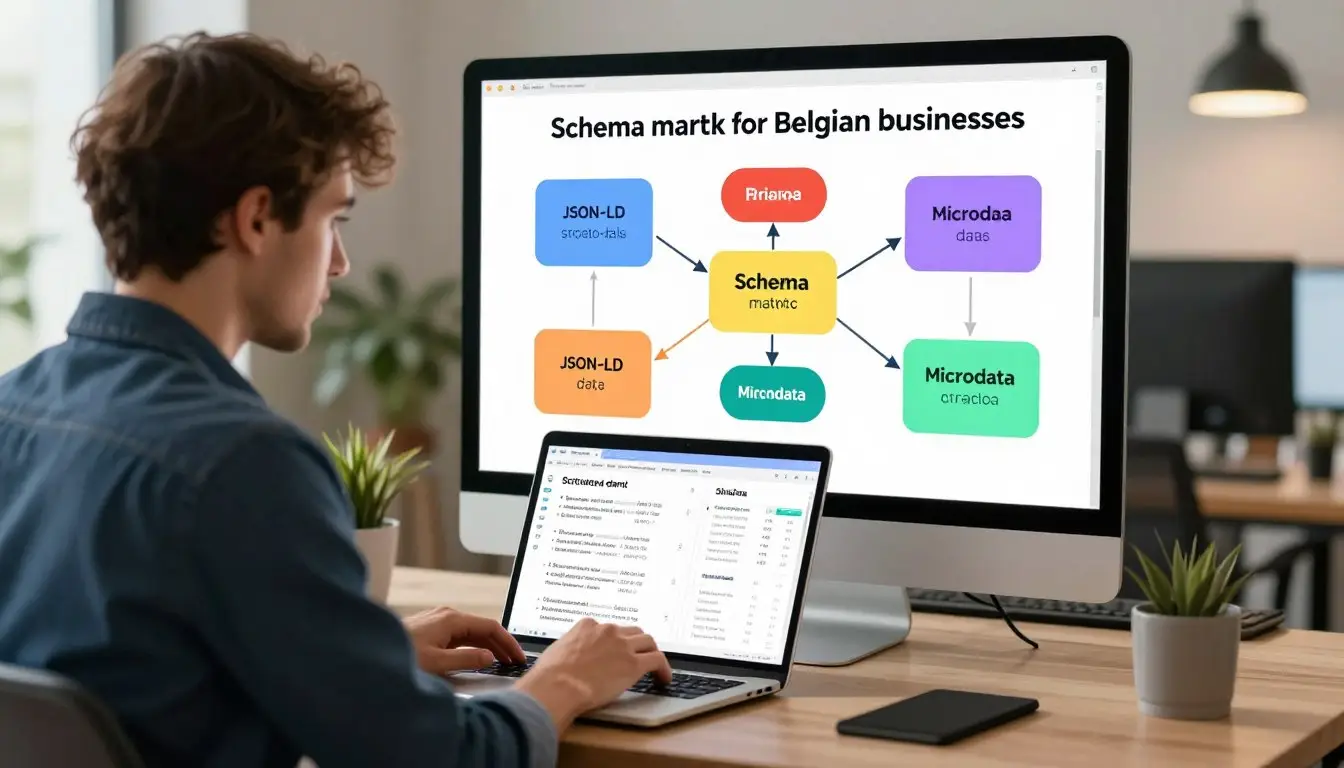
Free tools to test your current Schema :
- Google Rich Results Test - official Google validation for Schema types eligible for enhanced display.
- Schema Markup Validator - pure, exhaustive Schema.org validation.
- Browser extension Detailed SEO Extension (Chrome/Firefox) for one-click inspection of page markup.
Visit Structured Data Testing Tool was deprecated in 2023 - use only the two validators above.
Step 5 - Auditing technical SEO and crawlability by AI robots
AI engines operate their own crawlers: GPTBot (OpenAI), Google-Extended (Gemini), PerplexityBot, ClaudeBot (Anthropic), OAI-SearchBot. If your robots.txt blocks them - by accident or ignorance - you're invisible to these AIs, period.
The technical fundamentals of an AI visibility audit :
- Robots.txt permissive towards the AI crawlers you wish to authorize (business decision: whether to authorize or block depends on your strategy).
- Loading speed in line with Core Web Vitals LCP < 2.5s, INP < 200ms, CLS < 0.1.
- Clean XML Sitemap, submitted to Google Search Console and Bing Webmaster Tools.
- Semantic URLs in French (or local language), short, with no extraneous parameters.
- Unique metadata per page (title 50-60 characters, meta description 140-160).
- Native mobile version - AIs prioritize the mobile version.
| Technical element | Importance for AIs | Recommended action |
|---|---|---|
| Loading speed (LCP) | High | Cache + CDN + WebP/AVIF + European hosting |
| URL architecture | Average | Short, semantic slugs in French |
| Metadata (title + description) | High | Single per page, keyword focus at start |
| Robots.txt and access to AI crawlers | Review | Explicitly allow GPTBot, Google-Extended, PerplexityBot |
| XML Sitemap | Average | Submit to Search Console + Bing |
Step 6 - Measure the relevance of your content to AI responses
AI engines rate content according to three criteria: ability to respond directly to a question, conciseness and structure of the answer, reliability and freshness information cited. Content that ticks all three is massively more likely to be cited than vague content.
The format AIs prefer - empirically observed on hundreds of Perplexity and Gemini quotes:
- 2-3 sentence introduction which defines the subject and already gives the main answer.
- Numbered list or table immediately after introduction.
- Thematic H2 sections with one H3 or dense paragraph per sub-question.
- Concrete figures, precise dates, names of entities - no «a lot», «often», «generally».
- FAQ at the bottom of the page with variations on long-tail queries.
«AIs don't reward eloquence. They reward accuracy, structure, and the ability to provide a self-contained response in less than 80 words.» - WEBIPHI internal GEO methodology
Step 7 - Strengthen your brand presence on the web
Beyond the site, your brand must exist in the ecosystem that AIs crawl. Five concrete levers for a Belgian SME:
- Google Business Profile optimized - complete file, precise main category, regular photos, systematic replies to reviews.
- Reliable Belgian directories - PagesPro, Hub.brussels, BECI, Agoria depending on your sector. Absolute NAP consistency.
- Active LinkedIn company profile - AIs rely heavily on LinkedIn to validate the existence and legitimacy of a B2B brand.
- Press presence - a press release published on L'Écho, Trends or Datanews is worth dozens of backlinks for AIs.
- Structuring social networks - LinkedIn, YouTube, X (formerly Twitter), Facebook. Our guide to social networking for companies in the Benelux covers usage by platform.
Immediate action plan for Brussels companies
Four actions to launch this week, in order:
- Perform the manual tests in Step 1 on ChatGPT, Gemini and Perplexity. Document your starting position - that's your baseline.
- Audit your current Schema.org with Google Rich Results Test on your 5 main pages (home, services, contact, 2 articles).
- Check your robots.txt - the most common mistake is to block GPTBot without measuring its impact.
- Restructure semantically your 3 most strategic pages (including homepage): unique H1, short paragraphs, FAQ, dense named entities.
For an overview of your website and your global digital presence, ask for a free audit - WEBIPHI covers both traditional Google visibility and AI visibility in the same report.
FAQ - AI visibility audit for Belgian companies
What is an AI visibility audit and why is it crucial for my company in Belgium?
An AI visibility audit measures your brand's presence in responses generated by ChatGPT, Gemini, Perplexity, Claude and Google AI Overviews. For a Belgian company in 2025, this has become as critical as a classic Google SEO audit: users are increasingly asking their business questions directly to an AI, without going through Google's blue links. Not appearing in AI recommendations means missing out on a growing share of the market.
How do you actually appear in the responses of ChatGPT and other conversational agents?
Three cumulative levers: semantically structured content (clean H1/H2, self-supporting paragraphs, tagged FAQs), dense Schema.org markup (LocalBusiness, Organization, FAQPage, Service), and mentions on sources that AIs deem reliable (Belgian business press, Wikipedia, institutional directories, active LinkedIn company profile). None of these levers is sufficient on its own; combined over 6 to 12 weeks, the results are measurable.
What's the difference between traditional SEO and SEO for AI (GEO)?
Traditional SEO seeks to position a page in the Google SERPs on keywords. GEO (Generative Engine Optimization) seeks to have a brand quoted in AI-generated responses. The former optimizes for clicks, the latter for citations. The two disciplines complement each other: a site that ranks on Google without being cited by the AIs loses AI market share; a site cited by the AIs without ranking on Google misses out on the majority of web traffic.
Is there an online audit tool to test my current AI visibility?
No mature consumer tool to date - the market is too young. The reliable method is still manual: 30 minutes of structured testing on ChatGPT, Gemini, Perplexity and Claude, with a monthly follow-up spreadsheet. WEBIPHI offers a free professional audit that combines these manual tests with Schema, robots.txt and semantic structure analysis.
What impact does Schema.org structured data have on my AI visibility?
High. AI engines use Schema markup as an explicit signal to understand your business, your location, your offers and your reliability. A page with LocalBusiness + FAQPage + Organization correctly implemented is between 3 and 5 times more likely to be cited in a geolocated response than a page without Schema - observed on WEBIPHI customers since the end of 2024.
Why does web performance influence my AI visibility?
AI crawlers (GPTBot, PerplexityBot, Google-Extended) abandon pages that are too slow. A site that exceeds 3 seconds of Largest Contentful Paint will be partially or totally ignored by the crawler. Core Web Vitals are therefore as much an SEO factor as a GEO one. The rule: aim for LCP < 2.5s, INP < 200ms, CLS < 0.1.
Is it too late to start a strategy for AI visibility in Brussels in 2025?
No, it's precisely the right time. The Belgian market is 12 to 18 months behind the Anglo-Saxon markets in GEO practices. Local competition is weak, and the window of opportunity is open. A company that starts up now can take the benchmark position in its sector before the competition does.
How much does a professional IA visibility audit cost in Belgium?
WEBIPHI offers a free IA visibility audit (4-page diagnostic package, delivered within 48 hours). For a full audit of an entire site, with actionable recommendations and an implementation plan, expect to pay between €800 and €2,500 plus VAT, depending on site size and scope. The free audit is sufficient to assess the scope of the project and decide whether to go further.
Request your free AI visibility audit
WEBIPHI supports Belgian SMEs, freelancers and e-businesses on AI visibility from Brussels. Free, no-obligation audit delivered within 48 hours We test your presence in the 5 main AI engines, analyze your Schema.org, check your robots.txt, and give you an actionable report with your site's top 5 priorities. Request yours via our home page or contact us directly web agency in Brussels.